<?xml version="1.0" encoding="utf-8"?>
<feed xmlns="http://www.w3.org/2005/Atom">
    <id>https://www.rightview.ai/blog</id>
    <title>Rightview AI Blog</title>
    <updated>2026-09-21T00:00:00.000Z</updated>
    <generator>https://github.com/jpmonette/feed</generator>
    <link rel="alternate" href="https://www.rightview.ai/blog"/>
    <subtitle>Insights on clinical research, AI, and operations</subtitle>
    <icon>https://www.rightview.ai/img/Rightview_White_Square.png</icon>
    <rights>© 2026 Rightview Technologies Inc.</rights>
    <entry>
        <title type="html"><![CDATA[Trust in Rightview Agents]]></title>
        <id>https://www.rightview.ai/blog/trust-in-rightview-agents</id>
        <link href="https://www.rightview.ai/blog/trust-in-rightview-agents"/>
        <updated>2026-09-21T00:00:00.000Z</updated>
        <summary type="html"><![CDATA[When we set out to build Rightview, we knew we were after both high-performance and, more importantly, clinical-grade trust.]]></summary>
        <content type="html"><![CDATA[<p>When we set out to build Rightview, we knew we were after both high-performance and, more importantly, clinical-grade trust.</p>
<p><img decoding="async" loading="lazy" alt="Trust in Rightview Agents" src="https://www.rightview.ai/assets/images/trust-thumbnail-e6f5201c7d7a1d3b8dabdfb7c44d1d34.png" width="1200" height="675" class="img_ev3q"></p>
<p>Agents are notoriously hard to productionalize properly, especially in a protected domain like clinical trials. In order to maintain quality, our development and production cycles go through a series of rigorous test gates that give us conviction in new features - and in our product. This is what it means to build and iterate on production agents as fast as we do - coding agents give us scale but our trust process gives us confidence.</p>
<h2 class="anchor anchorTargetStickyNavbar_Vzrq" id="we-ship-fast-but-nothing-ships-on-blind-trust">We ship fast, but nothing ships on blind trust<a href="https://www.rightview.ai/blog/trust-in-rightview-agents#we-ship-fast-but-nothing-ships-on-blind-trust" class="hash-link" aria-label="Direct link to We ship fast, but nothing ships on blind trust" title="Direct link to We ship fast, but nothing ships on blind trust" translate="no">​</a></h2>
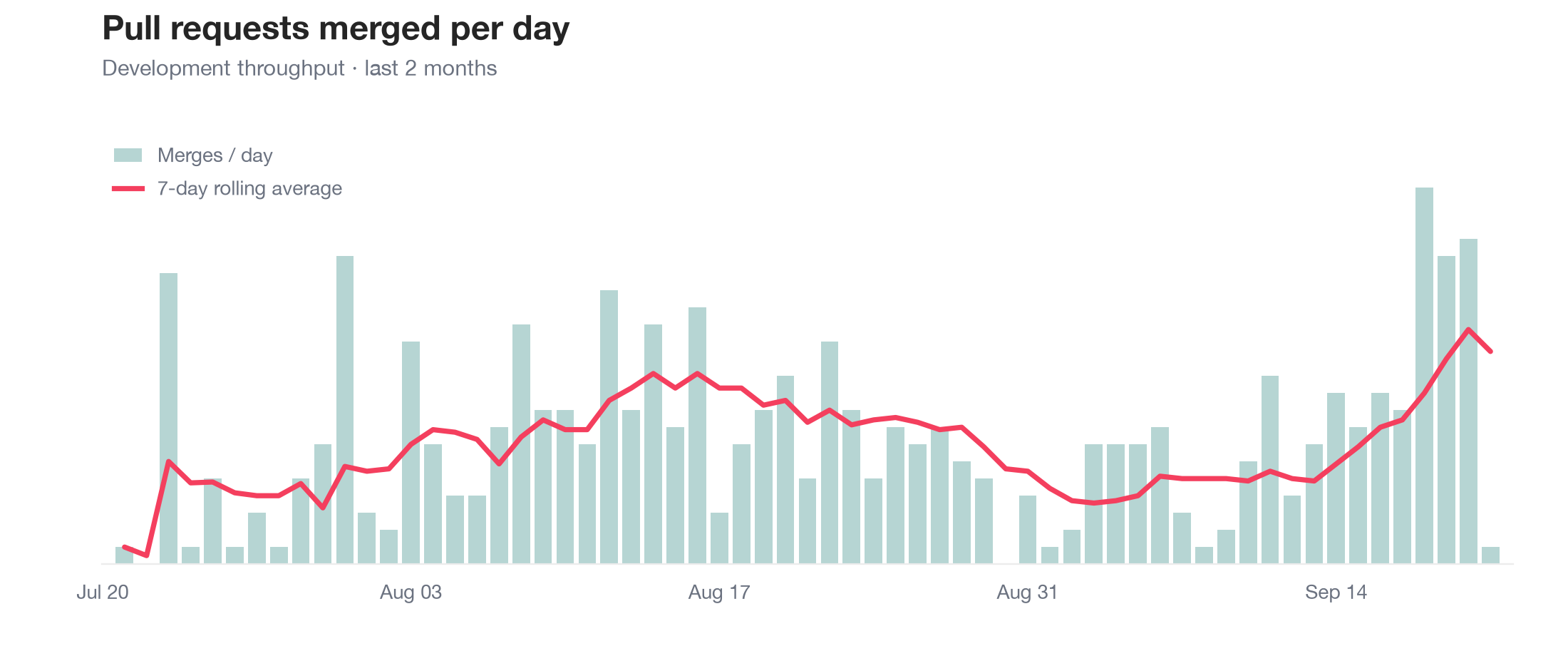
<p>We merge 85% of our code changes in less than <strong>four hours</strong> - even as our code volume accelerates.</p>
<p><img decoding="async" loading="lazy" alt="Pull requests merged per day at Rightview over the last two months, showing accelerating throughput" src="https://www.rightview.ai/assets/images/trust-pr-throughput-96ad7283031eab405711b50d7a09c3d8.png" width="2200" height="920" class="img_ev3q"></p>
<p>We ship fast, but nothing ships on blind trust. Roughly a quarter of our substantive changes (<strong>23.9%</strong>) get stopped at test gates and require iteration before they earn their way into the product. This friction is purposeful and helps us gain <strong>conviction</strong> in what passes our gates.</p>
<p>We combine a mix of traditional heuristics from software development with advanced and novel techniques in AI-testing to deliver truly strong agentic performance in production. Of course, the entire development to testing to production pipeline is automated - our developers and coding agents get feedback and correct in real-time.</p>
<h2 class="anchor anchorTargetStickyNavbar_Vzrq" id="during-development">During development<a href="https://www.rightview.ai/blog/trust-in-rightview-agents#during-development" class="hash-link" aria-label="Direct link to During development" title="Direct link to During development" translate="no">​</a></h2>
<p><em>Maintaining high code quality before code reaches professionals.</em></p>
<h3 class="anchor anchorTargetStickyNavbar_Vzrq" id="testing-the-software">Testing the software<a href="https://www.rightview.ai/blog/trust-in-rightview-agents#testing-the-software" class="hash-link" aria-label="Direct link to Testing the software" title="Direct link to Testing the software" translate="no">​</a></h3>
<p>Every code change must clear <strong>2,000+ mandatory tests</strong> before it can merge:</p>
<ul>
<li class=""><strong>Playwright</strong> automated flow testing</li>
<li class=""><strong>Regression tests</strong> for every single bug and incident we've ever seen</li>
<li class=""><strong>Functional tests</strong> for every feature</li>
<li class=""><strong>SAST / DAST</strong> automated security scanning</li>
<li class=""><strong>Cursor Bugbot</strong> review - an AI reviewer that reads every change and flags likely bugs before a person does</li>
<li class=""><strong>Claude Code</strong> reviews - a second AI reviewer that checks the change against our standards and explains what it found</li>
<li class=""><strong>Daily Cursor</strong> code scanning and security reviews</li>
</ul>
<h3 class="anchor anchorTargetStickyNavbar_Vzrq" id="testing-the-rightview-agent">Testing the Rightview agent<a href="https://www.rightview.ai/blog/trust-in-rightview-agents#testing-the-rightview-agent" class="hash-link" aria-label="Direct link to Testing the Rightview agent" title="Direct link to Testing the Rightview agent" translate="no">​</a></h3>
<p>Ensuring improvements to the agent are truly progressive:</p>
<ul>
<li class=""><strong>Golden-set evaluation</strong> on every single production release - we grade each release against a curated set of questions with known-correct answers, so we can prove it still gets them right</li>
<li class=""><strong>Statistical analysis at scale</strong> - we run the new version and the current one against a large volume of real-world cases and compare the results, so an improvement in one area never quietly makes something else worse</li>
</ul>
<h2 class="anchor anchorTargetStickyNavbar_Vzrq" id="in-production">In production<a href="https://www.rightview.ai/blog/trust-in-rightview-agents#in-production" class="hash-link" aria-label="Direct link to In production" title="Direct link to In production" translate="no">​</a></h2>
<p><em>Identifying issues in real time and guarding against failures.</em></p>
<ul>
<li class=""><strong>Comprehensive logging</strong>, tagged by service line</li>
<li class=""><strong>Live answer-evaluation metrics</strong> - hallucination detection, agentic planning, and tool-call quality, measured on real traffic</li>
<li class=""><strong>Observability</strong> across the stack</li>
</ul>
<h2 class="anchor anchorTargetStickyNavbar_Vzrq" id="compliance-and-documentation">Compliance and documentation<a href="https://www.rightview.ai/blog/trust-in-rightview-agents#compliance-and-documentation" class="hash-link" aria-label="Direct link to Compliance and documentation" title="Direct link to Compliance and documentation" translate="no">​</a></h2>
<p>Rightview has partnered with <strong>Vanta</strong> for SOC 2 compliance. We've already achieved <strong>HIPAA compliance</strong>. View our trust center here: <strong><a href="https://trust.rightview.ai/" target="_blank" rel="noopener noreferrer" class="">trust.rightview.ai</a></strong>.</p>]]></content>
        <category label="ai" term="ai"/>
        <category label="engineering" term="engineering"/>
        <category label="trust" term="trust"/>
        <category label="clinical-trials" term="clinical-trials"/>
    </entry>
    <entry>
        <title type="html"><![CDATA[From Funder to Founder in Life Sciences AI]]></title>
        <id>https://www.rightview.ai/blog/from-funder-to-founder-life-sciences-ai</id>
        <link href="https://www.rightview.ai/blog/from-funder-to-founder-life-sciences-ai"/>
        <updated>2026-08-07T00:00:00.000Z</updated>
        <summary type="html"><![CDATA[Our conversation on Court Square Group's podcast about making the leap from evaluating life sciences AI companies to building one.]]></summary>
        <content type="html"><![CDATA[<p>We sat down with Court Square Group for Season 2, Episode 12 of their series on life sciences investing and innovation, this time on the other side of the table: what it's like moving from funding life sciences AI companies to founding one.</p>
<div style="position:relative;padding-bottom:56.25%;height:0;overflow:hidden;max-width:100%;margin:1.5rem 0"><iframe src="https://www.youtube.com/embed/z1JtR9J05o4" title="From Funder to Founder in Life Sciences AI. S2 E12" frameborder="0" allow="accelerometer; autoplay; clipboard-write; encrypted-media; gyroscope; picture-in-picture; web-share" allowfullscreen="" style="position:absolute;top:0;left:0;width:100%;height:100%"></iframe></div>
<h2 class="anchor anchorTargetStickyNavbar_Vzrq" id="what-we-covered">What we covered<a href="https://www.rightview.ai/blog/from-funder-to-founder-life-sciences-ai#what-we-covered" class="hash-link" aria-label="Direct link to What we covered" title="Direct link to What we covered" translate="no">​</a></h2>
<p>The conversation traces the path from sitting on the funder's side of the table, sourcing and evaluating life sciences AI companies, to starting Rightview and building for the friction we kept seeing in clinical trial execution firsthand. We talk through what that transition actually looks like: the shift in mindset from diligence to execution, what we learned from watching dozens of pitches before ever writing a plan of our own, and why the operational bottlenecks in trials (not the drug discovery headlines) are where we chose to build.</p>
<p>If you're evaluating life sciences AI as an investor, an operator, or a founder weighing the same jump, this one's worth a watch.</p>]]></content>
        <category label="life-sciences-ai" term="life-sciences-ai"/>
        <category label="founder-journey" term="founder-journey"/>
        <category label="clinical-trials" term="clinical-trials"/>
        <category label="podcast" term="podcast"/>
    </entry>
    <entry>
        <title type="html"><![CDATA[Prediction Markets Have No Place in Clinical Trials]]></title>
        <id>https://www.rightview.ai/blog/kalshi-prediction-markets-clinical-trials</id>
        <link href="https://www.rightview.ai/blog/kalshi-prediction-markets-clinical-trials"/>
        <updated>2026-07-16T00:00:00.000Z</updated>
        <summary type="html"><![CDATA[Kalshi's new biotech prediction market lets the public bet on FDA approvals and trial outcomes. Here's why that's dangerous for patients, sites, and the integrity of the data itself.]]></summary>
        <content type="html"><![CDATA[<p>Kalshi just launched biotech prediction markets as a pilot program, letting the public bet on outcomes like FDA approvals and clinical trial results. We think that's a serious mistake.</p>
<p><img decoding="async" loading="lazy" alt="Kalshi biotech prediction markets" src="https://www.rightview.ai/assets/images/kalshi-prediction-markets-dd9051443e8da19bc50246cbc6d60156.png" width="212" height="144" class="img_ev3q"></p>
<p>Prediction markets are often defended as a way to aggregate dispersed information - the idea that a large enough crowd, with money on the line, converges on the truth faster than any single expert. That logic holds up reasonably well for elections and sporting events. <strong>Clinical trials are neither.</strong></p>
<p>The people with the most valuable information about a trial - researchers, sponsors, industry insiders - may also have access to material, non-public information. Allowing money to trade on that information doesn't aggregate anything; it creates serious openings for market manipulation, conflicts of interest, and the misuse of confidential trial data.</p>
<h2 class="anchor anchorTargetStickyNavbar_Vzrq" id="the-displayed-odds-can-shape-the-outcome-theyre-predicting">The displayed odds can shape the outcome they're predicting<a href="https://www.rightview.ai/blog/kalshi-prediction-markets-clinical-trials#the-displayed-odds-can-shape-the-outcome-theyre-predicting" class="hash-link" aria-label="Direct link to The displayed odds can shape the outcome they're predicting" title="Direct link to The displayed odds can shape the outcome they're predicting" translate="no">​</a></h2>
<p>The displayed odds can also begin to shape the outcome they are supposedly predicting. A large bet against a trial could influence investors, potential partners, physicians, and public perception before the data are released - regardless of the underlying science.</p>
<h2 class="anchor anchorTargetStickyNavbar_Vzrq" id="patients-are-not-passive-subjects-in-this-market">Patients are not passive subjects in this market<a href="https://www.rightview.ai/blog/kalshi-prediction-markets-clinical-trials#patients-are-not-passive-subjects-in-this-market" class="hash-link" aria-label="Direct link to Patients are not passive subjects in this market" title="Direct link to Patients are not passive subjects in this market" translate="no">​</a></h2>
<p>Imagine enrolling in a clinical trial, taking an experimental therapy, and then watching strangers place increasingly large bets that your trial will fail. That could erode trust, increase anxiety, and make patients more likely to withdraw - directly affecting retention, data quality, and potentially the trial's outcome. Trust in clinical research by patients is already a big barrier for the industry.</p>
<p>Clinical trials depend on confidentiality, scientific integrity, and the trust of patients taking on real personal risk. When betting markets meet clinical trials, it isn't just an abstract outcome being priced - it's a person's hope for a therapy, converted into a line on a leaderboard. Patients enroll in trials seeking access to new treatment, not to become the subject of financial speculation.</p>
<p>We at Rightview stand firmly against this.</p>]]></content>
        <category label="clinical-trials" term="clinical-trials"/>
        <category label="regulatory-affairs" term="regulatory-affairs"/>
        <category label="data-privacy" term="data-privacy"/>
    </entry>
    <entry>
        <title type="html"><![CDATA[We Analyzed 2M+ Pharma Payments to Clinical Sites. Here's What We Found.]]></title>
        <id>https://www.rightview.ai/blog/site-payments-benchmark-2m</id>
        <link href="https://www.rightview.ai/blog/site-payments-benchmark-2m"/>
        <updated>2026-07-10T00:00:00.000Z</updated>
        <summary type="html"><![CDATA[Cost per site has barely moved since 2014 - even as trial duration, arm count, and enrollment have all climbed sharply. That gap is a leading indicator of coordinator turnover and site drop-off.]]></summary>
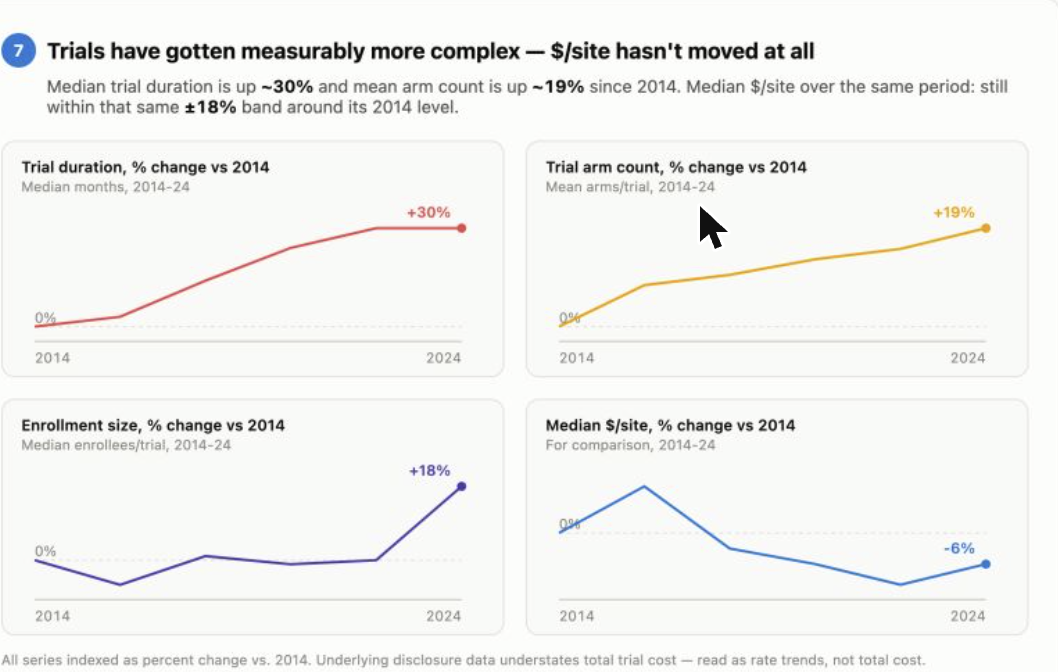
        <content type="html"><![CDATA[<p>We analyzed 2M+ pharmaceutical payments to clinical sites and mapped them back to 10,000 clinical trials. The big takeaway: <strong>cost per site has been relatively stable since 2014, despite a massive increase in protocol complexity.</strong></p>
<p><img decoding="async" loading="lazy" alt="Trials have gotten measurably more complex - $/site hasn&amp;#39;t moved at all" src="https://www.rightview.ai/assets/images/site-payments-benchmark-49d5ceb570568ef633ffc26202d4af1f.png" width="1058" height="672" class="img_ev3q"></p>
<p>Median trial duration is up roughly 30% since 2014. Mean arm count is up roughly 19% over the same period. Median enrollment per trial is up 18%. Meanwhile, median dollars per site sits within an 18% band of where it was a decade ago - essentially flat once you account for normal year-to-year noise.</p>
<p>Sites are clearly taking on more burden: longer trials, more arms to manage, more patients to enroll and track. Compensation has not kept pace.</p>
<h2 class="anchor anchorTargetStickyNavbar_Vzrq" id="why-the-gap-matters">Why the gap matters<a href="https://www.rightview.ai/blog/site-payments-benchmark-2m#why-the-gap-matters" class="hash-link" aria-label="Direct link to Why the gap matters" title="Direct link to Why the gap matters" translate="no">​</a></h2>
<p>That gap matters: sites absorbing more work without more pay is a leading indicator of coordinator turnover, slower enrollment, and site drop-off - the kind of risk that shows up in your timelines before it shows up in your budget.</p>
<h2 class="anchor anchorTargetStickyNavbar_Vzrq" id="want-the-numbers-behind-your-own-trials">Want the numbers behind your own trials?<a href="https://www.rightview.ai/blog/site-payments-benchmark-2m#want-the-numbers-behind-your-own-trials" class="hash-link" aria-label="Direct link to Want the numbers behind your own trials?" title="Direct link to Want the numbers behind your own trials?" translate="no">​</a></h2>
<p>We built this analysis using our extensive payments and financial dataset spanning thousands of trials and sites. If you want real-time, cutting-edge financial benchmarking for your own clinical operations - comparing your site compensation against comparable trials in your therapeutic area - <a href="mailto:research@rightview.ai" target="_blank" rel="noopener noreferrer" class="">reach out to us at research@rightview.ai</a> and we'll send over a custom report.</p>]]></content>
        <category label="clinical-trials" term="clinical-trials"/>
        <category label="operations" term="operations"/>
        <category label="ai" term="ai"/>
    </entry>
    <entry>
        <title type="html"><![CDATA[Discovery Is Being Industrialized. Trial Execution Is Not.]]></title>
        <id>https://www.rightview.ai/blog/ai-drug-discovery-vs-trial-execution</id>
        <link href="https://www.rightview.ai/blog/ai-drug-discovery-vs-trial-execution"/>
        <updated>2026-07-02T00:00:00.000Z</updated>
        <summary type="html"><![CDATA[Anthropic's Claude Science is the latest AI workbench for scientists - and every one of the molecules it helps find still has to run through a clinical trial. Better models don't solve that problem.]]></summary>
        <content type="html"><![CDATA[<p>If we had a LinkedIn follower for every new AI-powered drug discovery company we come across... Last week, Anthropic revealed Claude Science, an AI workbench for scientists, setting off another round of discussion around frontier labs' role in the future of AI drug discovery.</p>
<p>The excitement is earned. AI really can accelerate discovery, and that's exactly where the frontier labs are focused.</p>
<p><img decoding="async" loading="lazy" alt="The discovery engine is scaling fast - AI-discovered molecules in clinical development, 2016-2026" src="https://www.rightview.ai/assets/images/ai-discovery-vs-execution-168d86684141f2ac93606f9cc02e1ac8.png" width="1034" height="926" class="img_ev3q"></p>
<p>The number of AI-discovered molecules entering clinical development has gone from <strong>3 in 2016</strong>, to <strong>17 in 2020</strong>, to <strong>67 in 2023</strong>, to an estimated <strong>200+ in 2026</strong>.</p>
<h2 class="anchor anchorTargetStickyNavbar_Vzrq" id="but-every-one-of-those-molecules-still-has-to-run-through-a-clinical-trial">But every one of those molecules still has to run through a clinical trial<a href="https://www.rightview.ai/blog/ai-drug-discovery-vs-trial-execution#but-every-one-of-those-molecules-still-has-to-run-through-a-clinical-trial" class="hash-link" aria-label="Direct link to But every one of those molecules still has to run through a clinical trial" title="Direct link to But every one of those molecules still has to run through a clinical trial" translate="no">​</a></h2>
<p>That means finding the right sites and patients, and navigating the administrative and compliance workflows that sit across a fragmented stack of systems. Better models don't solve those problems.</p>
<p>The people running large pharma know it. Novartis CEO Vas Narasimhan, who also sits on Anthropic's board, attributes roughly 40% of drug-development time to just two things: <strong>missing information and the difficulty of running operations.</strong> Both are execution problems, not discovery problems - and both are addressable with purpose-built AI workflows and process.</p>
<p>The majors are already capturing those gains. Bristol Myers Squibb CEO Chris Boerner has described generating thousands of use cases with at least a 5–10% productivity lift across the organization. At that scale, that kind of operational return compounds fast.</p>
<h2 class="anchor anchorTargetStickyNavbar_Vzrq" id="the-catch">The catch<a href="https://www.rightview.ai/blog/ai-drug-discovery-vs-trial-execution#the-catch" class="hash-link" aria-label="Direct link to The catch" title="Direct link to The catch" translate="no">​</a></h2>
<p>Big pharma has the people and budgets to build purpose-built tooling for its own operations. The nimble companies - the lean sponsors and sites doing more with less - don't. They're left running the same fragmented, manual workflows with fewer people, while the majors pull further ahead on exactly the layer where the time and money are hiding.</p>
<p><strong>Our mission is to level the playing field for those organizations.</strong></p>
<p>Discovery is being industrialized. Trial execution is not.</p>]]></content>
        <category label="ai" term="ai"/>
        <category label="clinical-trials" term="clinical-trials"/>
        <category label="operations" term="operations"/>
    </entry>
    <entry>
        <title type="html"><![CDATA[How CRX Handles a Real Governance Question]]></title>
        <id>https://www.rightview.ai/blog/crx-navigating-ambiguity</id>
        <link href="https://www.rightview.ai/blog/crx-navigating-ambiguity"/>
        <updated>2026-06-18T00:00:00.000Z</updated>
        <summary type="html"><![CDATA[A coordinator asked about a missed visit caused by a supply delay. Here's how CRX found the answer across 20+ sources, synthesized a response, and cited every claim back to the original text.]]></summary>
        <content type="html"><![CDATA[<p>The clinical world is full of questions, exceptions, and ambiguity. We built Rightview CRX to help coordinators navigate it.</p>
<p>Here's a real example: a coordinator asked about a missed visit caused by a supply delay. CRX identified the appropriate governance documents across 20+ sources, synthesized a response with every claim cited, and linked straight back to the original source texts across FDA guidance, ICH, GCP, CFR, and more.</p>
<p><img decoding="async" loading="lazy" alt="CRX chat interface answering a governance question, with cited source PDF preview" src="https://www.rightview.ai/assets/images/crx-governance-demo-e80fb166f3c2b755fa9acc04d26e01da.png" width="1092" height="620" class="img_ev3q"></p>
<p>Governance is just scratching the surface - we're already live with our customers, bringing the same grounded, clinical-grade intelligence to their specific workflows.</p>
<p>Try CRX for free at <a href="https://crx.rightview.ai/" target="_blank" rel="noopener noreferrer" class="">crx.rightview.ai</a>.</p>]]></content>
        <category label="clinical-research" term="clinical-research"/>
        <category label="regulatory-affairs" term="regulatory-affairs"/>
        <category label="ai" term="ai"/>
        <category label="gcp" term="gcp"/>
    </entry>
    <entry>
        <title type="html"><![CDATA[Takeaways from DIA 2026 Global Annual Meeting]]></title>
        <id>https://www.rightview.ai/blog/dia-2026-annual-meeting-recap</id>
        <link href="https://www.rightview.ai/blog/dia-2026-annual-meeting-recap"/>
        <updated>2026-06-09T00:00:00.000Z</updated>
        <summary type="html"><![CDATA[Regulators from the FDA, UK's MHRA, and Japan's PMDA shared data on GCP inspections and the future of drug development. Three takeaways from the sessions.]]></summary>
        <content type="html"><![CDATA[<p>This is a truly international summer, with the World Cup in full swing and the energy at DIA 2026 Annual Meeting, which brought together a global audience including top regulators from the FDA, UK's MHRA, and Japan's PMDA. These agencies shared interesting data across GCP inspections and spoke on the future of drug development.</p>
<p><img decoding="async" loading="lazy" alt="Welcome to DIA 2026 Global Annual Meeting" src="https://www.rightview.ai/assets/images/dia2026-recap-1-4208460742b6484a7a9c8fd5b5f442f3.png" width="398" height="528" class="img_ev3q"></p>
<p>A few of our takeaways from the sessions:</p>
<p><strong>1. Monitoring and safety review are moving from reactive to continuous.</strong> There was strong consensus that oversight is shifting from point-in-time, manual, and reactive toward continuous and automated.</p>
<p><strong>2. Protocol adherence and record-keeping drive inspection outcomes.</strong> In the FDA's data, the deficiencies that pushed an inspection's classification up or down were concentrated in two areas: protocol adherence and adequacy of records. The serious-sounding findings get the attention, but these are what actually move the outcome.</p>
<p><img decoding="async" loading="lazy" alt="Top Deficiency Areas: Protocol &amp;amp; Records - upgrades and downgrades breakdown from DIA 2026" src="https://www.rightview.ai/assets/images/dia2026-recap-2-def8273f7794ceceb1e69d2a5e9ce586.png" width="706" height="528" class="img_ev3q"></p>
<p><strong>3. Regulatory signal exists, but it lives in disparate sources.</strong> There was an open call to bring together warning letters, 483s, inspection findings, and more, which currently sit siloed across disparate sources. The bottleneck isn't missing information - it's that no one is connecting it. <em>(Spoiler alert: we've done this. Stay tuned for a future post!)</em></p>
<h2 class="anchor anchorTargetStickyNavbar_Vzrq" id="the-hard-truth">The hard truth<a href="https://www.rightview.ai/blog/dia-2026-annual-meeting-recap#the-hard-truth" class="hash-link" aria-label="Direct link to The hard truth" title="Direct link to The hard truth" translate="no">​</a></h2>
<p>The rules themselves aren't always clear and easy to find. Guidance is scattered across agencies and documents, and teams are stitching it together by hand. What gave us optimism was watching three regulators from three continents share openly, and hear how we are all moving toward the same goals.</p>
<p>Drug development improves the more we open up and connect what already exists. That's the work ahead, and it's worth it for patients everywhere.</p>]]></content>
        <category label="regulatory-affairs" term="regulatory-affairs"/>
        <category label="gcp" term="gcp"/>
        <category label="clinical-trials" term="clinical-trials"/>
    </entry>
    <entry>
        <title type="html"><![CDATA[Introducing Rightview CRx for Clinical Research Professionals]]></title>
        <id>https://www.rightview.ai/blog/introducing-rightview-crx</id>
        <link href="https://www.rightview.ai/blog/introducing-rightview-crx"/>
        <updated>2026-06-08T00:00:00.000Z</updated>
        <summary type="html"><![CDATA[A free regulatory Q&A resource for busy clinical research professionals - grounded in ICH, GCP, CFR, and FDA guidance, with every answer cited to the source.]]></summary>
        <content type="html"><![CDATA[<p>We're excited to announce the launch of Rightview CRx - a one-of-its-kind free regulatory Q&amp;A resource built for busy clinical research professionals.</p>
<p>Most regulatory questions don't have a single answer. They're spread across disparate, rapidly changing sources: ICH guidelines, GCP standards, the Code of Federal Regulations, FDA guidance documents, and more. We kept hearing the same pain point from people across clinical research: there had to be a better way to get answers for tough regulatory questions.</p>
<p>Rightview CRx is designed for trust and speed. Ask your question in plain language, and we automatically search for the answers. Our insights are grounded in real documents from verified institutions - and every sentence is cited back to the source.</p>
<video controls="" width="100%" class="blog-video"><source src="/video/rightview-crx-launch.mp4" type="video/mp4"><p>Your browser does not support the video tag.</p></video>
<p><a href="https://crx.rightview.ai/" target="_blank" rel="noopener noreferrer" class="">Try Rightview CRx at crx.rightview.ai</a> - it's free.</p>
<p>Thanks to the many sites, sponsors, and research professionals who gave us input and feedback on this product. You're the reason we built it.</p>
<p>Read the original announcement on <a href="https://www.linkedin.com/feed/update/urn:li:activity:7470120066752286720/" target="_blank" rel="noopener noreferrer" class="">LinkedIn</a>.</p>]]></content>
        <category label="clinical-research" term="clinical-research"/>
        <category label="regulatory-affairs" term="regulatory-affairs"/>
        <category label="gcp" term="gcp"/>
        <category label="ai" term="ai"/>
        <category label="clinical-operations" term="clinical-operations"/>
    </entry>
    <entry>
        <title type="html"><![CDATA[Your Trial Data is Probably Not Private]]></title>
        <id>https://www.rightview.ai/blog/your-trial-data-is-probably-not-private</id>
        <link href="https://www.rightview.ai/blog/your-trial-data-is-probably-not-private"/>
        <updated>2026-03-20T00:00:00.000Z</updated>
        <summary type="html"><![CDATA[What really happens when you use cloud AI with your clinical trials?]]></summary>
        <content type="html"><![CDATA[<p>At this point, no one is unfamiliar with the convenience of modern AI tools. We use it everywhere, outsourcing tedious tasks so that we're unlocked to do bigger, better things. The ROI is obvious, but the risks are not.</p>
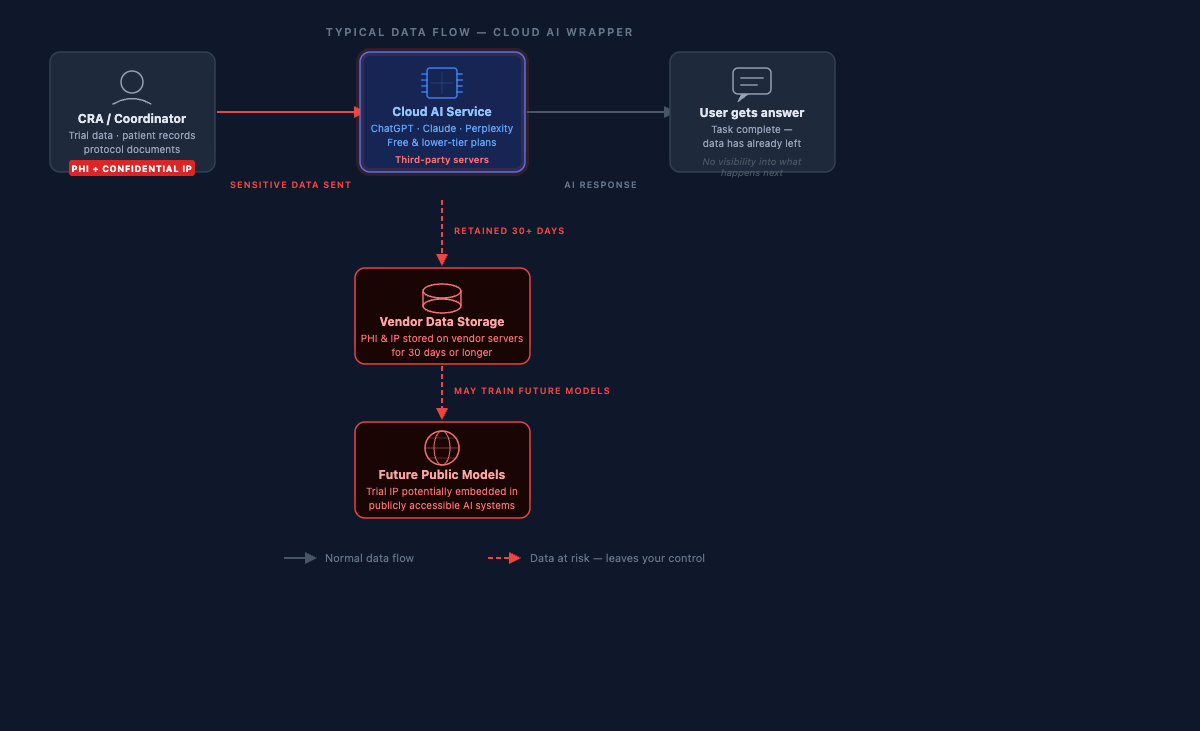
<p>Most of the vendors we know and love - OpenAI, Anthropic, Perplexity - all actively incentivize users to switch to their more commercially viable plans by insisting on using any data in their lower tiers as fodder for training future models. If your CRAs or coordinators go visit ChatGPT today and upload sensitive trial or patient details, <strong>those details are essentially changing hands and being used to train future publicly accessible models</strong>. What's worse, even if you do have a higher tier with these services, they may still <strong>retain your data for 30 days or longer.</strong></p>
<p>The unapproved usage of potentially risky tools is called <strong>shadow AI</strong>. It's a very real risk - some <a href="https://www.sapiosciences.com/news/research-finds-scientists-view-elns-as-glorified-filing-cabinets-driving-frustration-duplication-and-shadow-ai-use/" target="_blank" rel="noopener noreferrer" class="">studies</a> say up to 45% of life sciences professionals use unauthorized tools on a weekly basis. But the dangers of data privacy in AI tools goes beyond just the chatbots: it's critical to ensure that the <strong>vendors you work with also treat that data with care.</strong> Ask the tough questions: "where is my data going?" and "are my details being used for training models?".</p>
<p><img decoding="async" loading="lazy" alt="Typical data flow through a cloud AI wrapper - showing how clinical trial data passes through third-party servers, is retained, and may be used to train future public models" src="https://www.rightview.ai/assets/images/cloud-ai-data-flow-1ec01a19e10bf361b3680993cebac329.png" width="1200" height="731" class="img_ev3q"></p>
<p>Because clinical trial data is both protected health information (PHI) <em>and</em> intellectual property, it is critical that organizations are aware of how it is being exposed in AI workflows. Most large enterprises solve the shadow AI problem by directly onboarding onto an enterprise AI account with a Business Associate Agreement (BAA) in place - ultimately, a costly process with immediate vendor lock-in. Others go the hyperscaler route and leverage their cloud providers (Google GCP, Amazon AWS, Microsoft Azure), which is subject to <em>their</em> agreements with AI providers and their own data training and retention policies.</p>
<p>The solution is not to avoid AI, but to use it the right way to minimize risk and maximize ROI. There is a better way.</p>
<h3 class="anchor anchorTargetStickyNavbar_Vzrq" id="how-rightview-handles-sensitive-data">How Rightview handles sensitive data<a href="https://www.rightview.ai/blog/your-trial-data-is-probably-not-private#how-rightview-handles-sensitive-data" class="hash-link" aria-label="Direct link to How Rightview handles sensitive data" title="Direct link to How Rightview handles sensitive data" translate="no">​</a></h3>
<p>At Rightview, we're taking a completely different approach to maintain <a href="https://trust.rightview.ai/" target="_blank" rel="noopener noreferrer" class="">trust, security, and privacy</a>. We've adopted open-source models that run in an encrypted, protected environment through our partnerships with trusted vendors who practice zero data retention (ZDR) - they don't even store the data, much less use it to train models. We're CFR Part 11 compliant and are trusted by sites and sponsors alike. Reach out to us at <a href="mailto:research@rightview.ai" target="_blank" rel="noopener noreferrer" class="">research@rightview.ai</a> to learn more about how we're powering AI-applications across the life sciences space and get a copy of our data security brief.</p>]]></content>
        <category label="ai" term="ai"/>
        <category label="clinical-trials" term="clinical-trials"/>
        <category label="security" term="security"/>
        <category label="data-privacy" term="data-privacy"/>
    </entry>
    <entry>
        <title type="html"><![CDATA[Beyond Drug Discovery: The Hidden Friction Slowing Clinical Trials]]></title>
        <id>https://www.rightview.ai/blog/beyond-drug-discovery-hidden-friction-clinical-trials</id>
        <link href="https://www.rightview.ai/blog/beyond-drug-discovery-hidden-friction-clinical-trials"/>
        <updated>2026-01-22T00:00:00.000Z</updated>
        <summary type="html"><![CDATA[Anthropic's presentation at JPM Healthcare on its strategy in life sciences felt strangely polarizing. On one hand, hearing Dario discuss the velocity of change and the promise of AI in life sciences was exciting-but on the other hand, it felt like the same critical blockers that have held back efforts in the past decade were largely unaddressed.]]></summary>
        <content type="html"><![CDATA[<p>Anthropic's presentation at JPM Healthcare on its strategy in life sciences felt strangely polarizing. On one hand, hearing Dario discuss the velocity of change and the promise of AI in life sciences was exciting-but on the other hand, it felt like the same critical blockers that have held back efforts in the past decade were largely unaddressed.</p>
<p>Dario said, <em>"where AI is going, maybe we could have a much faster rate of these drug discoveries. And then everything comes downstream from that. That leads to more discoveries of fundamental biology. That leads to more drug candidates. That leads to drugs that have larger effect sizes and so can go faster through clinical trials which leads to better care for patients."</em></p>
<p>While drug discovery is a powerful and very real use case for AI, <strong>it doesn't automatically translate into faster clinical trials or better care for patients</strong>. Once a drug leaves the lab and enters the clinic, progress is shaped by the operational reality of how trials are executed day to day.</p>
<h2 class="anchor anchorTargetStickyNavbar_Vzrq" id="the-unglamorous-friction-points">The Unglamorous Friction Points<a href="https://www.rightview.ai/blog/beyond-drug-discovery-hidden-friction-clinical-trials#the-unglamorous-friction-points" class="hash-link" aria-label="Direct link to The Unglamorous Friction Points" title="Direct link to The Unglamorous Friction Points" translate="no">​</a></h2>
<p>Everyone talks about accelerating trials. Few want to discuss the unglamorous friction points slowing them down. One of the clearest examples lives far downstream from drug discovery, in a workflow most sponsors rarely see: <strong>how patient data moves from clinical systems into trial databases</strong>.</p>
<p>Clinical Research Coordinators spend hours every week doing something that sounds almost unbelievable to anyone outside the industry: <strong>entering the same exact patient data into multiple systems multiple times</strong>.</p>
<p>A patient's blood pressure is 128/82. The nurse writes it in the chart during the visit. The coordinator records it on a tracking worksheet. Later, they log into the EDC and type the same numbers into separate fields. If it's a safety endpoint, they enter it again in another module. <strong>Same data, four entries.</strong> Coordinators we've talked to describe this as <em>"death by a thousand clicks."</em></p>
<p>This is the norm and it's burning out the very people trials depend on. So why does this still happen? The answer lies in how clinical trials evolved, and what got locked in place when the industry went digital.</p>
<h2 class="anchor anchorTargetStickyNavbar_Vzrq" id="how-we-got-here">How We Got Here<a href="https://www.rightview.ai/blog/beyond-drug-discovery-hidden-friction-clinical-trials#how-we-got-here" class="hash-link" aria-label="Direct link to How We Got Here" title="Direct link to How We Got Here" translate="no">​</a></h2>
<p>For decades, clinical trials ran entirely on paper. Sponsors provided <strong>Protocols</strong>, or blueprints describing how a trial should run. Sites used <strong>Case Report Forms (CRFs)</strong>, or structured documents derived from the protocol to record specific data at each patient visit. Source documents like medical records and lab reports held the raw clinical data.</p>
<p>Data lived in one physical place and moved physically between site and sponsor. There was one version of the truth, even if it took weeks to reach the sponsor's desk.</p>
<p>When <strong>Electronic Data Capture (EDC) systems</strong> emerged in the late 1990s and early 2000s, they digitized the sponsor's side of the equation. Faster database lock. Remote monitoring. Audit trails. Sponsors could finally see data in near real-time instead of waiting for paper forms to arrive by courier.</p>
<p>But EDCs didn't change how data originates at the site. Patient visits still happen in hospital systems, outpatient clinics, and research facilities using platforms designed for patient care, not trial compliance. Sites kept working in <strong>Electronic Medical Records (EMRs)</strong>, lab systems, and paper worksheets because that's what patient care required.</p>
<blockquote>
<p><strong>70% of sites report that more than 50% of their EDC data is re-entered from existing EHR data <a href="https://www.clinicalleader.com/doc/a-few-clicks-and-done-automating-edc-data-entry-0001" target="_blank" rel="noopener noreferrer" class="">(Clinical Leader)</a>.</strong></p>
</blockquote>
<h2 class="anchor anchorTargetStickyNavbar_Vzrq" id="the-system-divide">The System Divide<a href="https://www.rightview.ai/blog/beyond-drug-discovery-hidden-friction-clinical-trials#the-system-divide" class="hash-link" aria-label="Direct link to The System Divide" title="Direct link to The System Divide" translate="no">​</a></h2>
<p>Clinical systems and trial systems evolved with different goals. <strong>EMRs are designed for clinical care</strong> and <strong>EDC systems are designed for regulatory compliance</strong> with sponsor oversight and FDA inspections.</p>
<p>Neither system was built to talk to the other. Even when they technically could, they rarely do. The gap between them became a permanent feature of the landscape. So coordinators fill it manually. Every visit. Every patient. Every data point.</p>
<h2 class="anchor anchorTargetStickyNavbar_Vzrq" id="the-real-cost">The Real Cost<a href="https://www.rightview.ai/blog/beyond-drug-discovery-hidden-friction-clinical-trials#the-real-cost" class="hash-link" aria-label="Direct link to The Real Cost" title="Direct link to The Real Cost" translate="no">​</a></h2>
<p>A typical Phase 2 trial might require <strong>30-40 data points per patient visit</strong>. A coordinator running multiple trials might manage <strong>20-30 active patients at a time</strong>. If even half of those data points require manual transcription from one system to another, that's <strong>hundreds of redundant entries per week</strong>.</p>
<p>Every re-entry takes time. Every re-entry creates risk of typos, transposition errors, copy-paste mistakes. Those errors trigger queries from monitors, which require coordinators to pull source documents, write explanations, and re-verify data. More time. More clicking. <strong>Coordinators burn out and leave the industry entirely.</strong> And sponsors pay for all of it through longer timelines, higher monitoring costs, and preventable amendments.</p>
<blockquote>
<p><strong>31.2% of clinical research coordinators (CRCs) said they experienced stress because of contracts with sponsors. CRCs mentioned being overwhelmed by protocol changes, data entry requirements, and sending, updating, and resending documents <a href="https://www.florencehc.com/blog-post/combating-burnout-in-clinical-research/" target="_blank" rel="noopener noreferrer" class="">(Florence Healthcare)</a>.</strong></p>
</blockquote>
<h2 class="anchor anchorTargetStickyNavbar_Vzrq" id="widening-the-lens">Widening the Lens<a href="https://www.rightview.ai/blog/beyond-drug-discovery-hidden-friction-clinical-trials#widening-the-lens" class="hash-link" aria-label="Direct link to Widening the Lens" title="Direct link to Widening the Lens" translate="no">​</a></h2>
<p>This is where the optimism around AI in life sciences needs to widen its lens. Advances in drug discovery are real and meaningful, but once a molecule enters the clinic, outcomes are shaped by operational reality. <strong>Until the friction embedded in everyday trial execution is addressed, faster discovery alone won't deliver faster trials or better care.</strong></p>
<p>Fixing this type of friction is what we're focused on at <a class="" href="https://www.rightview.ai/sponsors">Rightview</a>. In our next post, we'll examine another workflow that has an outsized impact on timelines, sites, and sponsors alike.</p>
<p>If you are interested in learning more about how we're unifying unstructured data in clinical trials, <a href="mailto:research@rightview.ai" target="_blank" rel="noopener noreferrer" class="">reach out to us at research@rightview.ai</a>.</p>]]></content>
        <category label="clinical-trials" term="clinical-trials"/>
        <category label="ai" term="ai"/>
        <category label="operations" term="operations"/>
    </entry>
</feed>